For decades, the world measured technological progress by one simple standard: faster processors.
Every new generation of chips delivered more speed, greater efficiency, and higher performance. That steady evolution fueled the rise of personal computing, the internet, smartphones, cloud technology, and ultimately, artificial intelligence.
Today, however, the conversation is changing.
The challenge is no longer about making processors incrementally faster. It is about creating a computing platform capable of supporting the extraordinary demands of the AI era.
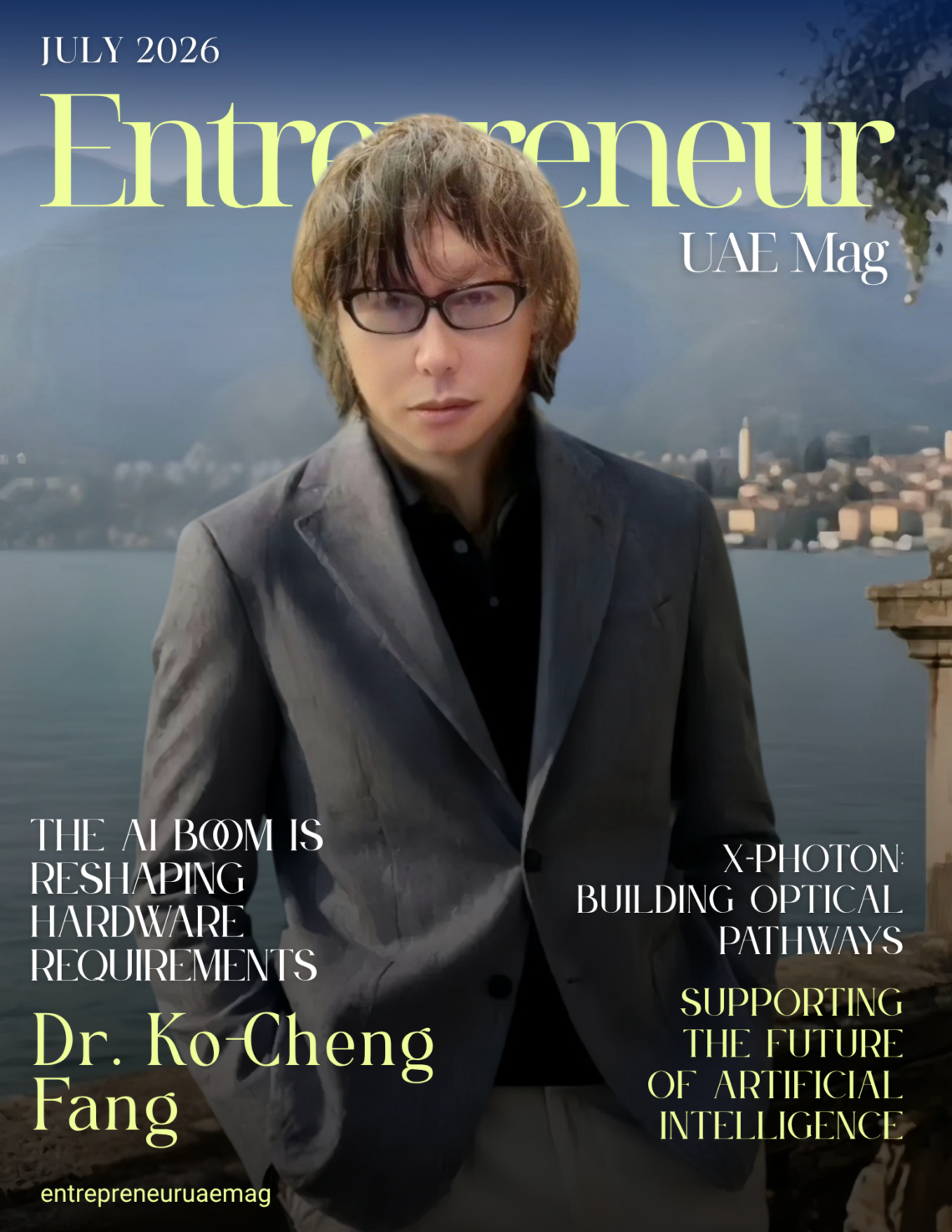
This is the challenge that Dr. Ko-Cheng Fang, Founder, CEO, and Chairman of LongServing Technology Co., Ltd., has chosen to address through years of research into photonic computing—a technology that replaces electronic data transmission with optical pathways driven by light.
Dr. Ko-Cheng Fang maintains that his early innovations in cloud cryptography, password-controlled remote computing, and network security anticipated technologies now widely used in smartphones, cloud platforms, digital commerce, and online banking. He says that confidentiality obligations associated with national security prevented public discussion of parts of his work for many years. Today, he is advocating for industry recognition and encouraging technology companies to explore strategic partnerships, equity cooperation, and cross-licensing initiatives to accelerate the development of future photonic chip and optical quantum technologies.
The AI Boom Is Reshaping Hardware Requirements
Artificial intelligence has become deeply integrated into modern society.
Businesses use AI to forecast markets and improve customer experiences. Hospitals rely on intelligent systems to assist doctors in diagnosing diseases. Engineers optimize manufacturing through machine learning, while universities employ AI to accelerate scientific discovery.
Behind every one of these applications lies an immense amount of computation.
The more capable AI becomes, the greater its demand for processing power.
Today’s data centers consume enormous amounts of electricity while operating thousands of processors around the clock. As AI models continue growing in size and complexity, these demands are expected to increase even further.
According to Dr. Fang, the future of artificial intelligence requires more than better software—it requires a new approach to hardware.
Looking Beyond Traditional Electronics

Modern processors depend on billions of electrons moving through microscopic semiconductor circuits.
This architecture has served the world remarkably well, but every new manufacturing generation introduces additional engineering challenges.
Heat becomes increasingly difficult to manage.
Power consumption continues rising.
Manufacturing grows more complicated as transistor dimensions approach physical limits.
Rather than continuing to push conventional electronics further, LongServing Technology is exploring an alternative built around photons.
Instead of electricity carrying information, the company’s research focuses on allowing light to perform that task.
Why Photons Matter
Photons behave differently from electrons.
They travel at extraordinary speed and generate significantly less heat during transmission.
These characteristics have made photonic computing one of the most promising research areas for scientists searching for alternatives to conventional semiconductor technology.
However, practical implementation has always been challenging.
Unlike electricity, light naturally continues traveling in straight lines.
Processors require information to move through highly complex networks filled with turns, intersections, memory units, and logic circuits.
Successfully controlling light within those environments has remained one of the field’s greatest engineering obstacles.
X-Photon: Building Optical Pathways
LongServing Technology believes it has made meaningful progress through the development of X-Photon, a proprietary optical material designed specifically for photonic information processing.
According to the company, X-Photon creates microscopic waveguides that allow photons to travel through carefully engineered optical pathways while remaining confined inside the circuit.
Unlike traditional semiconductor materials, the technology is designed around the natural movement of light.
The company believes this represents one of the essential building blocks for future optical processors.
Demonstrating Precision Optical Routing
Recently, LongServing Technology showcased one of the capabilities of X-Photon through a laboratory demonstration.
A laser beam successfully traveled through an optical channel before completing a precise 90-degree directional change inside the microscopic structure.
Although the demonstration may appear straightforward, its engineering significance is considerable.
Future photonic processors require light to travel through countless directional changes while moving between computational units, memory, and communication pathways.
According to the company, the successful demonstration validates an important step toward practical optical computing.
A New Architecture for Future Chips

Beyond optical materials, Dr. Fang has introduced new architectural concepts designed specifically for photonic processors.
Among them is the company’s 2nm Multi-Bit Optical Quantum Chip, which features a redesigned optical pathway layout optimized for photonic information flow.
LongServing Technology has also publicly released architectural diagrams illustrating its photonic chip design, optical pathway system, and a structural example of a photonic full-adder chip.
Unlike conventional electronic chips that often require numerous fabrication layers, the proposed architecture organizes the processor into three functional layers.
According to the company:
- The bottom layer is dedicated to photonic memory.
- The middle layer contains photonic logic gates responsible for computation.
- The top layer manages photonic communication pathways.
Each layer is fabricated using separate photomasks, creating a simplified optical architecture specifically designed for light-based computing.
According to Dr. Fang, integrating photonic memory directly into the processor could significantly improve computational efficiency because optical data can be accessed almost instantaneously.
Supporting the Future of Artificial Intelligence
LongServing Technology believes the next generation of AI infrastructure will require more than faster processors.
It will require an entirely new ecosystem.
The company’s long-term roadmap includes Photonic Cloud Computing Centers, photonic memory technologies, advanced optical communication systems, and integrated 2nm Multi-Bit Optical Quantum Chips working together as a unified computing platform.
According to the company, these technologies are intended to provide the infrastructure necessary for increasingly sophisticated AI applications while improving energy efficiency.
The company also reports that its optical computing research includes validation involving X-Photon materials capable of guiding light through precise 90-degree optical reflections, an achievement it considers fundamental to future photonic circuit design.
From Research to Global Development
Innovation requires both scientific progress and commercial support.
To accelerate future development, LongServing Technology recently announced a $500 million strategic financing initiative, based on a stated $2.5 billion corporate valuation.
According to the company, the investment will support continued materials research, manufacturing expansion, future photonic fabrication facilities, and the development of cloud computing infrastructure.
The company has also introduced a Strategic Equity Hedging Protocol, intended to encourage collaboration with organizations interested in participating in the commercialization of photonic technologies.
According to Dr. Fang, meaningful progress depends upon partnerships that combine scientific expertise with industrial capability.
Looking Beyond Today’s Technology
Every technological revolution begins long before it becomes mainstream.
Semiconductors once existed only inside research laboratories before transforming the modern world.
Artificial intelligence followed a similar path.
Photonic computing may now be entering its own period of exploration.
Whether light eventually becomes the foundation of future computing remains a question for continued scientific validation, engineering refinement, and industrial adoption.
What is already evident, however, is that researchers across the world are actively searching for technologies capable of supporting the next era of intelligent computing.
Through X-Photon materials, multi-layer photonic chip architecture, integrated photonic memory, optical routing technologies, and future Photonic Cloud Computing Centers, Dr. Ko-Cheng Fang and LongServing Technology are contributing to that global pursuit.
Rather than asking how far traditional electronics can continue evolving, Dr. Fang is asking a more ambitious question:
What if the next generation of computers no longer thinks with electricity—but with light?
Contact Information
Dr. Ko-Cheng Fang
Founder, CEO & Chairman
LongServing Technology Co., Ltd.
Email: service@longserving.com.tw
Website: https://longserving.com.tw/en/
Instagram: @ko_cheng_fang