Building the Next Computing Era
In every generation, a small number of entrepreneurs emerge not to optimize an existing industry, but to fundamentally replace it. These individuals do not chase trends; they build the conditions for new ones.
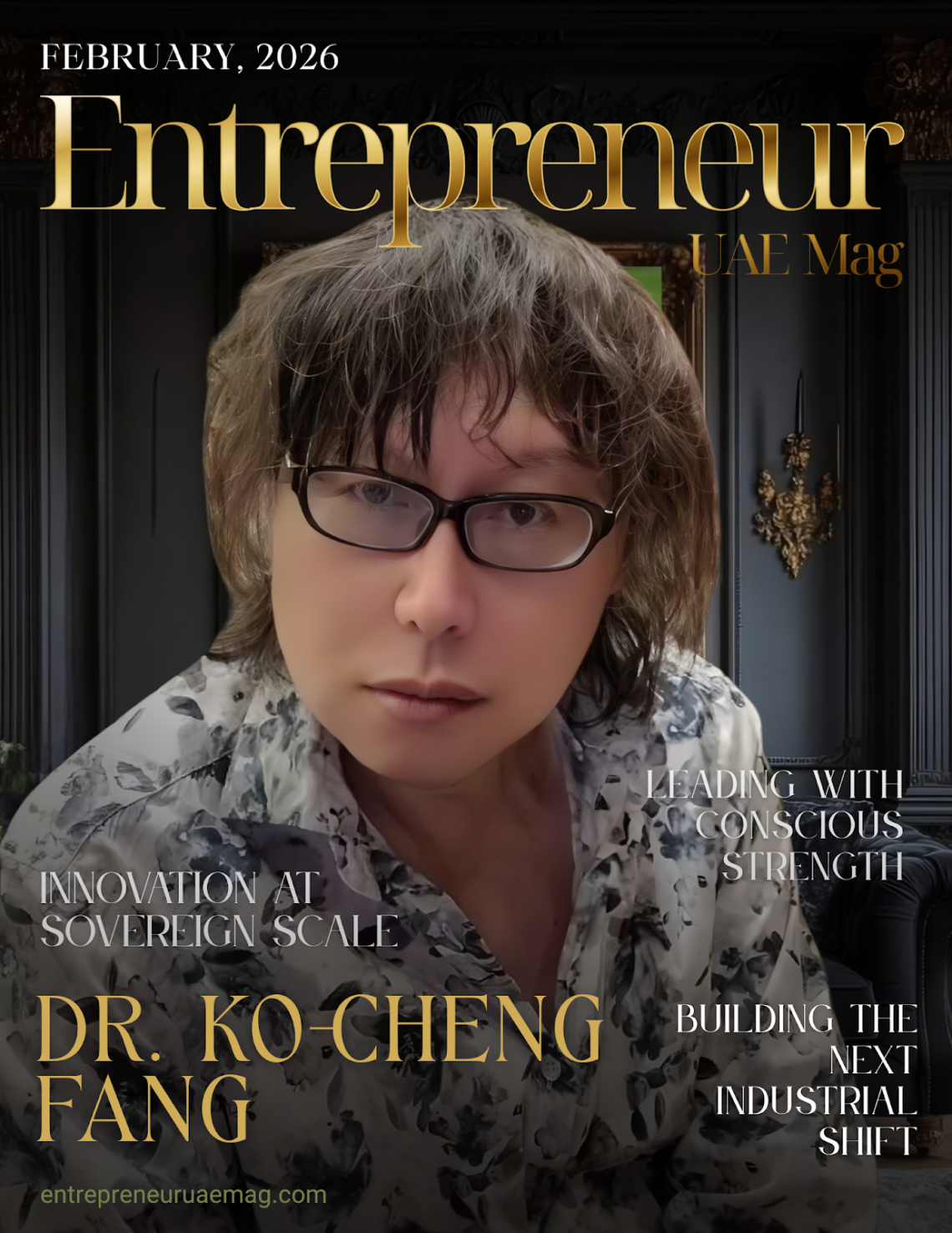
Dr. Ko-Cheng Fang, founder of LongServing Technology, belongs to this rare category. His work spans capital markets, cloud security architecture, laboratory-grown luxury materials, and now, most ambitiously, photonic quantum computing — a field he believes will redefine the global semiconductor industry.
For Fang, this is not merely a technological upgrade. It is a civilizational transition.
From Capital Autonomy to Deep-Tech Independence

Unlike many founders who begin their journeys inside accelerators or venture studios, Fang’s entrepreneurial foundation was built through financial markets. More than two decades ago, he stepped away from conventional employment and immersed himself in stock trading, where he generated substantial capital — at times earning close to one million NT dollars in a single day.
That early financial success gave him something most deep-tech founders lack: complete autonomy.
Without dependence on external investors, Fang could pursue long-horizon research unconstrained by quarterly expectations or premature exit pressure. This independence would later prove essential when he entered fields where meaningful progress requires years, not months.
His first major technological breakthrough came through the development of a cloud-based system protection architecture, integrating program-level encryption with distributed cloud verification. This technology was later requisitioned by the U.S. Department of Homeland Security, positioning Fang’s work within the domain of critical digital infrastructure.
Rather than capitalize on public recognition, Fang chose to remain largely behind the scenes — continuing to build.
Why the Semiconductor Industry Is Reaching Its Limits

To understand Fang’s current focus, one must first understand the constraints facing the global semiconductor industry.
Electronic semiconductors — the foundation of modern computing — rely on electrons traveling through increasingly dense circuits. For decades, Moore’s Law enabled predictable scaling. Today, that predictability is eroding.
Key challenges include:
- Thermal limits at advanced nodes
- Exponentially rising fabrication costs, often exceeding $20 billion per facility
- Escalating energy consumption in data centers
- Geopolitical concentration of supply chains
- National security risks tied to chip sovereignty
At the same time, demand is accelerating. Artificial intelligence, autonomous systems, smart cities, robotics, and defense applications require unprecedented computational throughput.
According to Fang, incremental improvements to electronic chips are no longer sufficient.
His solution: replace electrons with photons.
The Business Case for Photonic Quantum Computing
Photonic quantum chips operate using light rather than electrical charge. This shift may sound abstract, but its business implications are concrete.
Photons generate significantly less heat than electrons, reducing the need for extensive cooling systems. They are not affected by magnetic interference, improving resilience in extreme environments. And under optimized architectures, they offer the potential for orders-of-magnitude improvements in computational speed and energy efficiency.
Fang argues that photonic quantum chips address three critical pressures simultaneously:
- Performance scaling for AI-driven economies
- Energy efficiency aligned with sustainability mandates
- Infrastructure resilience against magnetic and electromagnetic disruptions
LongServing’s official platform:
https://www.longserving.com.tw/en/
Research and global foundry recruitment:
http://longserving.com.tw/en/Research-and-Implementation-Plan-for-Optical-Quantum-Chips/
For regions like the UAE — investing heavily in AI, data centers, autonomous mobility, aerospace, and smart infrastructure — these advantages carry strategic weight.
A Collaborative, Not Destructive, Disruption Strategy

One of Fang’s most distinctive strategic choices is his refusal to pursue immediate monopolization.
In theory, a successful photonic quantum architecture could justify aggressive vertical integration and market capture. Fang rejects this approach outright.
His reasoning is economic as much as ethical. The global semiconductor industry supports millions of jobs and underpins national pension systems, sovereign funds, and equity markets. A sudden displacement could trigger systemic financial instability.
Instead, Fang is actively recruiting manufacturing and foundry partners worldwide, positioning LongServing as a catalyst rather than a conqueror.
This collaborative model reduces transition risk and increases the probability of industry adoption — a critical factor in capital-intensive sectors where ecosystem alignment matters as much as innovation.
Vertical Integration Beyond Technology

Fang’s approach to photonic quantum computing is informed by an unexpected parallel: luxury.
Through LongServing, he successfully developed laboratory-grown Imperial Green jadeite, replicating geological processes that naturally take hundreds of millions of years. By controlling the source, process, and presentation, he eliminated supply constraints and positioned the product at the highest tier of the luxury market.
This mirrors strategies used by companies like De Beers — controlling raw material access to shape long-term value.
For investors, this history demonstrates Fang’s ability to execute end-to-end control, from scientific R&D to market positioning — a relevant capability when evaluating his semiconductor ambitions.
Reinventing Chip Architecture: Replacing Copper with Light

Photonic quantum chips, as designed by Dr. Ko-Cheng Fang, are not built upon increasingly complex metal interconnects or extreme lithographic miniaturization.
Instead of relying on dense copper wiring to transmit electrical signals, Fang’s architecture replaces conventional copper interconnects entirely with proprietary photonic quantum materials. These light-guiding materials allow the chip substrate itself to transmit photons, fundamentally reconfiguring logic architecture from electrical conduction to optical propagation.
This structural shift eliminates many of the fabrication complexities associated with advanced electronic semiconductor manufacturing — including multi-layer copper deposition, nanoscale etching, and extreme lithography requirements.
Lower Costs. Faster Production. Exponential Speed.
By replacing complex copper-based fabrication with material-driven light transmission, photonic quantum chips significantly simplify the production process. Fewer interconnect layers and reduced lithographic demands translate into lower manufacturing costs and faster production cycles compared to traditional electronic chips.
Beyond cost efficiency, the performance implications are substantial. Because photons move at light speed and generate minimal heat, Fang’s architecture has the potential to achieve computational acceleration of up to 1,000× faster than current electronic chips.
If validated at industrial scale, this approach could redefine competitive advantage across AI infrastructure, aerospace systems, defense computing, and next-generation data centers — positioning photonic quantum chips not merely as an upgrade, but as a structural evolution in computing architecture.
Leadership Philosophy: Calm Over Speed

Fang attributes much of his endurance to meditative discipline. While unconventional in traditional business narratives, mental resilience has become an increasingly valued leadership trait in high-pressure, high-uncertainty industries.
Deep-tech development involves long periods without external validation. Fang emphasizes calm analysis, patience, and synthesis — qualities that allow him to operate across disciplines without fragmentation.
In a world increasingly shaped by AI-assisted design and automation, his belief that humans should focus on high-level creative instruction while machines handle execution appears increasingly aligned with global trends.
The IPO and Scale Question
Fang has stated that LongServing could eventually enter public markets. For Entrepreneur readers, the critical question is timing and readiness.
Key milestones will likely include:
- Demonstrated photonic chip performance benchmarks
- Scalable manufacturing partnerships
- Integration pathways with existing systems
- Regulatory and national security alignment
Until those are met, LongServing occupies a strategic pre-scale position — attractive to early partners who understand frontier technology cycles.
Redefining Entrepreneurial Success

Perhaps most striking is Fang’s definition of success.
He rejects growth built on mass displacement. He believes innovation should elevate societies rather than fracture them. This philosophy informs his collaborative strategy and long-term outlook.
In an era where automation anxiety and geopolitical tension dominate economic discourse, such restraint may prove to be a competitive advantage.
The Road Ahead
The semiconductor industry is approaching an inflection point. Energy constraints, AI acceleration, and geopolitical pressures demand new architectures.
Photonic quantum computing may not replace electronic chips overnight — but the transition has begun.
For entrepreneurs, investors, and policymakers watching the future of computing, Dr. Ko-Cheng Fang represents a founder willing to think beyond incremental improvement and toward foundational change.
If the 20th century belonged to electrons, the 21st may belong to light.
And the entrepreneurs who understand that shift early will shape what comes next.